
On 22 June 2026, China’s National Medical Products Administration approved satri-cel — the world’s first CAR-T cell therapy cleared to treat a solid tumour. For two decades, CAR-T transformed blood cancers but repeatedly failed against solid ones. This is the approval that broke that barrier, and it happened in China first. Here is what it is, who it’s actually for, and — the question most articles skip — whether it’s a reason to get on a plane.
What was approved, precisely
The therapy is satricabtagene autoleucel — satri-cel, developed by CARsgen and sold in China as Kaileimei. China’s National Medical Products Administration approved it on 22 June 2026 for adults with Claudin18.2-positive, HER2-negative advanced gastric or gastro-oesophageal junction cancer who have already failed at least two prior lines of treatment.
Read that indication carefully, because every word of it is a gate. This is not a treatment for gastric cancer in general. It is for a specific molecular subtype (Claudin18.2-positive), in a specific setting (advanced), for patients who have already tried and exhausted the standard options. If you don’t match all of those, this particular news isn’t about you — and any company that tells you otherwise is selling.
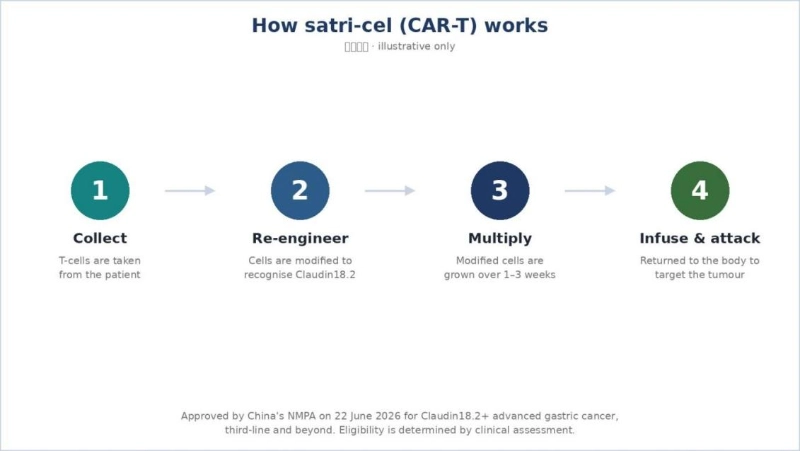
Why ‘solid tumour’ is the headline
CAR-T works by taking a patient’s own T-cells, re-engineering them to recognise a marker on the cancer, and returning them to the body to multiply and attack. Since 2017 it has produced remarkable results in blood cancers. Solid tumours resisted it for years — they hide behind antigen variability and a hostile microenvironment, and early attempts risked the engineered cells attacking healthy tissue that shared the same marker.
Satri-cel is the first to clear that bar in a regulatory approval anywhere in the world. A peer-reviewed phase trial reported a median overall survival of 7.92 months versus 5.49 months for standard care in this heavily pre-treated group — a real gain, and an honest one to state plainly: this is meaningful extra time for patients who had almost no options, not a cure.
It’s not the only thing that moved this year
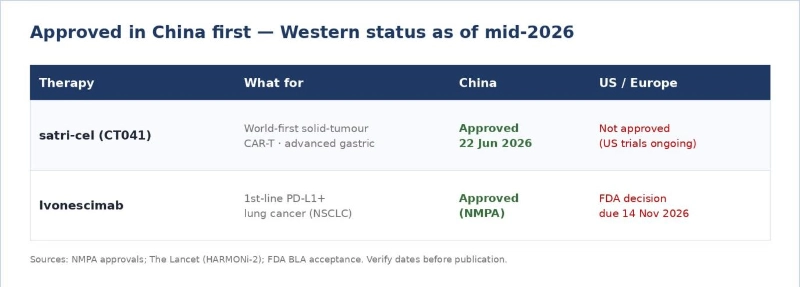
Satri-cel is the most striking single approval, but it sits inside a broader pattern. In the same period China’s regulator cleared ivonescimab (Akeso’s PD-1/VEGF bispecific antibody) for first-line PD-L1-positive non-small-cell lung cancer, on the strength of a head-to-head phase III trial in which it roughly halved the risk of progression compared with pembrolizumab — the current global standard. Ivonescimab is under FDA review in the United States with a decision expected in November 2026, which means, for now, it is available to patients in China before it is available in the West.
This is the pattern worth understanding, more than any single drug: a growing set of cancer therapies are reaching patients in China twelve to eighteen months before they clear European or American regulators — sometimes longer. Some are Chinese-invented; some are simply approved here first.
The honest part: should this bring you to China?
Here is where we part company with most of what you’ll read about this. A breakthrough being real is not the same as it being right for you. Three honest filters:
It has to match your disease, exactly. Satri-cel is for one molecular subtype of gastric cancer, in one clinical setting. Ivonescimab is for one type of lung cancer. Being newsworthy doesn’t widen an indication. The first thing to establish is whether your specific diagnosis fits — and that takes a specialist reading your actual file, not a headline.
Newer is not automatically better for your case. A third-line therapy for people who have exhausted standard treatment is not necessarily the right move for someone who hasn’t yet tried a first-line treatment that works perfectly well closer to home. Sometimes the established treatment in your own country is the better medicine. We’d rather tell you that than sell you a flight.
It’s a treatment decision, not a travel decision. CAR-T is demanding. Manufacturing takes weeks; the therapy has real side effects; and it needs a centre equipped to manage them. Whether it’s worth crossing a continent for depends entirely on your case, and the only responsible way to answer that is a specialist opinion first.
What to do if you think this might apply to you
Start by gathering the specific things a specialist needs to assess eligibility: your pathology report including molecular or biomarker testing (for satri-cel, Claudin18.2 status; for ivonescimab, PD-L1 status), your treatment history to date, and recent imaging. Without biomarker testing, no one can tell you whether these therapies are even a possibility — that test is the gate before every other question.
From there, a specialist review will establish whether you’re a candidate, what the realistic expectation is, and whether travelling makes sense at all. If it does, that’s a conversation about logistics. If it doesn’t, you’ve lost nothing but the cost of a consultation, and you have a written specialist opinion to take to your own doctor.